If you're shopping lift kits and truck accessories in Reading, start by deciding whether you need a leveling upgrade or a complete suspension lift. A leveling kit corrects factory rake and keeps daily manners intact, while a suspension lift kit adds clearance, wheel travel, and larger tire fitment. You'll want exact year, trim, drivetrain, and suspension details to verify Rough Country fitment. Budget for tires, alignment, and add-ons like steps, lights, or liners—you'll see how the right setup comes together.
Key Takeaways
- Opt for a leveling kit to address factory rake while maintaining near-stock performance and fitting bigger tires for daily driving.
- Go with a suspension lift kit for better ground clearance, wheel travel, and performance off-road, understanding steering and handling may shift.
- Confirm proper fitment by checking your truck's year, model, make, drivetrain, trim, cab, bed, and suspension setup prior to purchasing Rough Country parts.
- Match lift height and shock absorbers to your use, whether commuting, trail driving, towing, or heavy off-road use.
- Allocate funds for beyond just the kit cost, factoring in alignment, labor, wheels, tires, shocks, and add-on products including steps, lights, and liners.
Comparing Suspension Lift Kits and Leveling Kits
Even though both upgrades change your truck's stance, leveling kits and suspension lift kits fix different problems and deliver different outcomes. A leveling system tends to raise the front to meet the rear, correcting factory rake with limited change to geometry, ride height, and daily drivability. You select one if you want a cleaner profile and room for bigger tires.
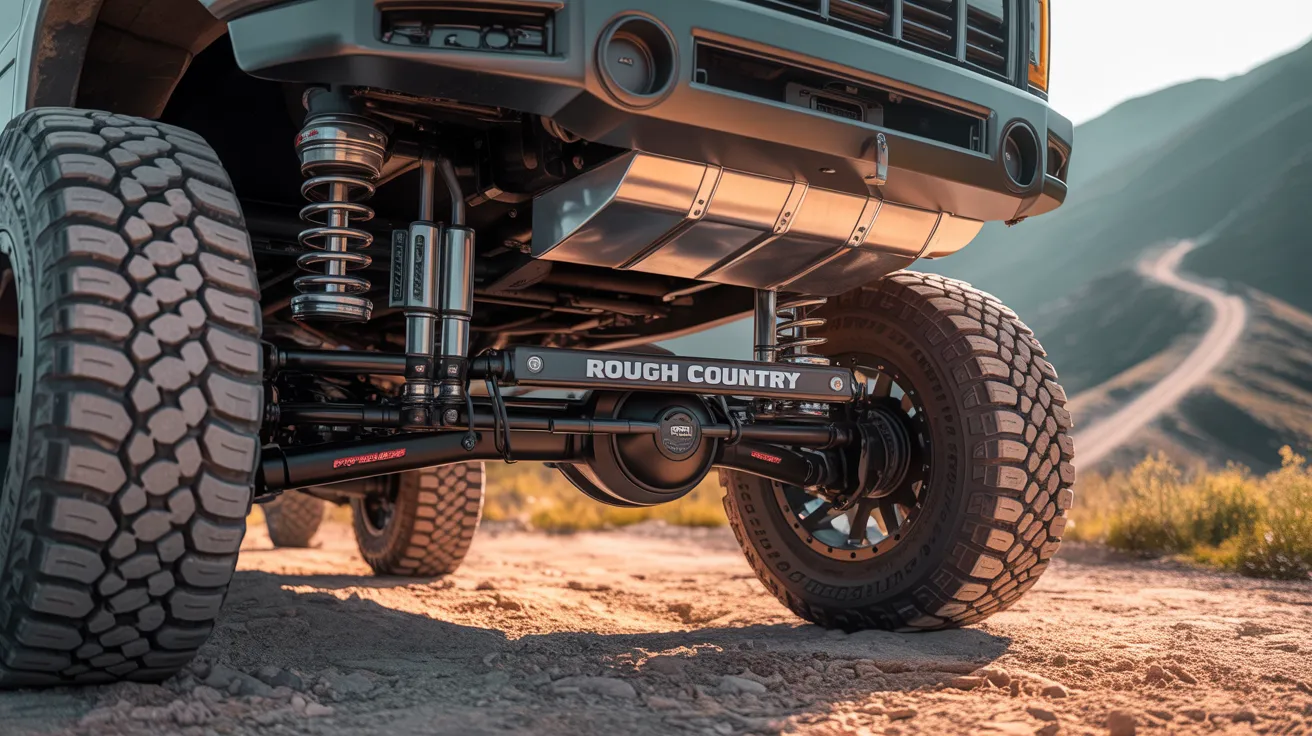
A suspension lift elevates the entire truck and adjusts key components to create more ground clearance and wheel travel. You'll see bigger gains in ride height, off-road capability, and tire options, yet you should anticipate handling changes, steering modifications, and a higher center of gravity. When you prefer subtle visual enhancement, use a leveling kit. If you need real clearance and articulation, apply a suspension lift and plan the supporting mods tailored to your use case.
Find the Rough Country lift kit that matches your truck.
Begin by documenting your truck's year, make, model, drivetrain, and intended use, because Rough Country designs lift kits for exact geometric requirements and performance standards. This data reveals which structural components and hardware can bolt on without clearance or alignment issues.
Next, check original ride height, cabin and bed configuration, axle configuration, and if your truck uses 2WD, 4WD, or adaptive suspension. Rough Country fitment guides streamline this check, but you still need to validate model compatibility against configuration-specific components and factory package variations. A kit that fits a Silverado 1500 may not fit a Trail Boss, and a Ram with air-spring suspension needs different adjustments than a vehicle with coil springs. By confirming fitment upfront, you avoid fitment surprises, compatibility issues, and reshipment delays.
Which Rough Country lift kit works with your driving habits?
Align the kit to your driving patterns, and you'll receive better ride quality, durability, and additional tire clearance without paying for features you won't need. If you mainly commute in your truck, select a basic Rough Country leveling kit or a 2- to 3.5-inch suspension setup tuned for daily comfort and consistent steering feel.
When you divide time between road and off-road use, go with a suspension system that includes premium shocks and corrected control arm angles. You'll enjoy stronger off road handling, superior articulation, and capacity for bigger tires without overstressing original components. For serious trail work, focus on raised struts, N3 or Vertex shock dampers, and suspension systems that preserve driveline geometry under load. A quality Rough Country package should align with load, speed, terrain, and your preferred ride firmness.
Top Rough Country Truck Accessories
Finish your suspension upgrade including Rough Country add-ons that tackle the actual issues you'll discover after the lift, new tires, and stance change. Go with improved entry steps or rock guards, that restore vehicle access and deliver lower-vehicle protection now that your truck sits higher and broader.
Then prioritize visibility and control. Rough Country LED light bars improve visibility range on dark trails, job sites, and rural roads without complex setup. Seat protectors and floor liners protect inside surfaces from soil, gravel, and water you'll track in after off-road use. Fender flares limit wheel spray and accent the expanded stance made by bigger tires. For towing or pulling, robust hitches, pulling hooks, and valuable guide bumpers that support winches add functionality without affecting fit. Select products that align with your truck's new geometry and workload.
What's the Right Budget for Your Build?
Once you've selected the lift kit and complementary components, establish a budget that exceeds the headline kit price. You'll require funds for shocks, rims, tires, alignment, installation costs, and any drivetrain or steering adjustments your platform needs. Brand reputation is crucial here; top-tier kits typically provide higher precision, superior ride comfort, and less installation trouble.
Regarding realistic budget ranges, anticipate basic spacer or leveling kits to start at lower prices, while comprehensive suspension packages with control arms, tuned dampers, and bigger tires rise quickly. Installation complexity, labor costs, and calibration work may contribute significantly. You ought to budget additional upgrades such as gear swaps, brake parts, and recovery tools if you intend for off-road use. If cash flow matters, compare financing options meticulously and emphasize consistency rather than fancy extras.
Common Questions Answered
Will Lift Kits Change My Factory Warranty?
Yes, lift systems can affect your manufacturer warranty, yet they won't necessarily void it. You face warranty problems when a dealer establishes the lift kit triggered or helped cause a breakdown. Drive system, steering, suspension, and drivetrain disputes often trigger dealer disputes. You must maintain installation documents, select quality parts, and follow service intervals. That helps you challenge denied claims and protect coverage where the modification wasn't responsible.
Do Bigger Tires Mean Re-Gearing?
Yes—if you jump several tire sizes, you'll typically need re-gearing. For instance, when switching from 31s to 35s, your truck may feel slow, hunt for gears, and build drivetrain stress under load. Adjusting gears reestablishes effective gear ratios, enabling you to recover acceleration, towing power, and transmission response. You might not need regearing for modest tire increases, however, if power, fuel economy, or shift quality drop, it's typically the best option.
When Should You Check Your Lift Kit?
You need to examine lift kit components once you hit 500 miles, afterwards at every oil change or 3,000 to 5,000 miles, depending on use. Periodic inspections enable you to catch wear on bushings, shock fluid leaks, damaged brackets, and alignment concerns ahead of time. Check Fastener torque post-aggressive terrain driving, cargo hauling, or hard impacts. When you operate in mud, salt, or rough terrain often, shorten intervals and examine steering and suspension parts at faster intervals.
Can a suspension kit change your truck's towing and payload performance?
Yes, a lift kit can alter your truck's towing and payload abilities. When you elevate ground clearance for greater clearance, you transform suspension geometry, center of gravity, and leverage on components. That can reduce stability when carrying load and increase drivetrain stress, particularly when using larger tires. You should obey your manufacturer's ratings unless an engineered kit clearly details upgraded ratings. Proper alignment, gearing, and brake performance are also critical.
Do Alignment Services Need attention after installing truck add-ons?
Yes—if attachments adjust height of ride, suspension structure, steering angles, or tire measurement, you must have an alignment. You'll feel the theory fast: tiny shifts can pull your truck off-center, scrub tread, and diminish handling. A quality alignment restores camber, caster angle value, and toe to manufacturer spec. After certain installs, you should also arrange brake calibration for autonomous driver system accuracy. You protect tire life, steering precision, and on-road safety by confirming alignment straight away.
Summary
Selecting the right lift package and components comes down to your truck usage, your desired look, and what your budget can handle. When you match a Rough Country lift kit to your driving style, you'll obtain power, ground room, and style that work together like a well-tuned drivetrain. Add smart accessories, organize your budget responsibly, and you'll build a pickup that's practical on the road, capable off it, and set for any future work.